

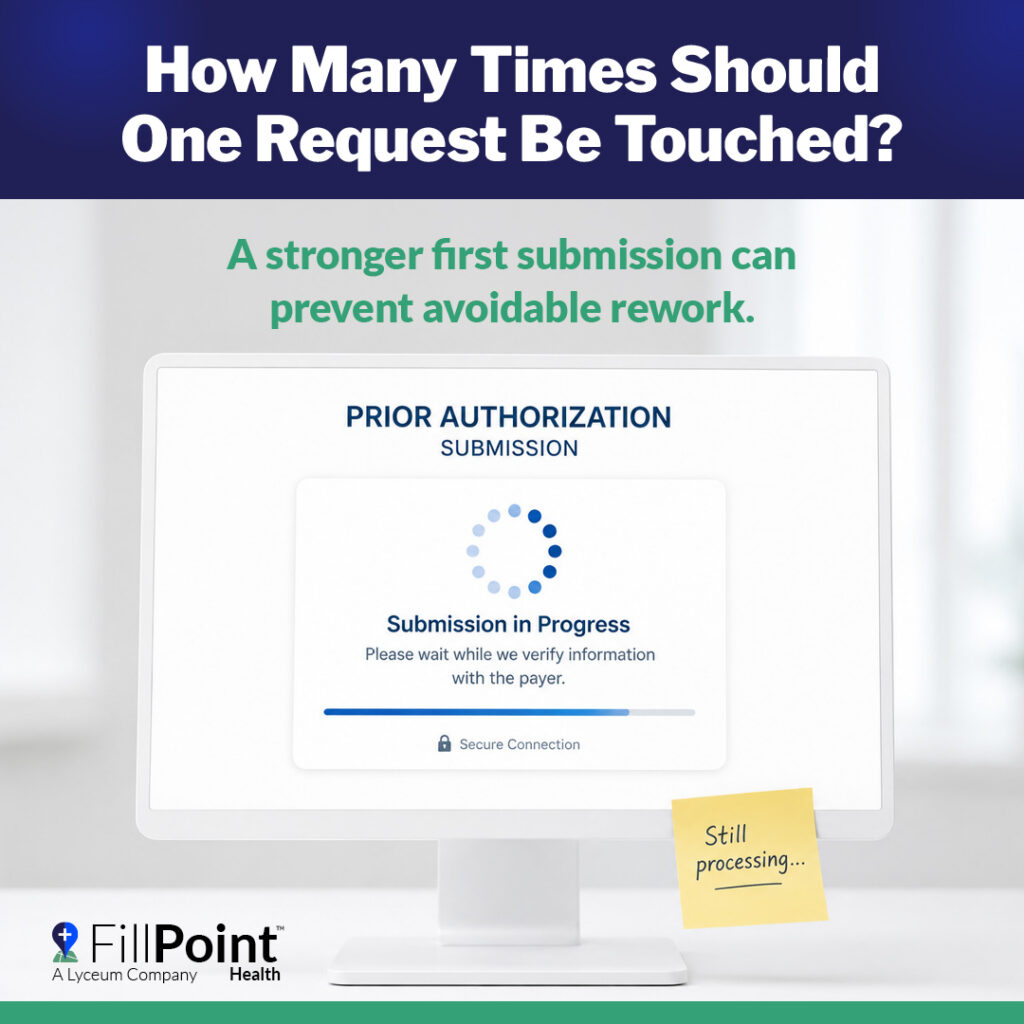
Prior authorization problems rarely end with the initial submission.
A missing clinical detail can trigger another payer request. A denial may require staff to revisit the chart or contact the patient. Each additional step takes time away from other work while the prescription remains unfilled.
For specialty practices, these delays can affect operating costs and the patient’s ability to begin treatment.
Prior Authorization Delays More Than the Prescription
Specialty medication requests often require documentation that reflects the payer’s current coverage criteria. Delays typically occur when:
- The submitted record does not address a specific payer requirement
- The prescription is routed through the wrong benefit pathway
Research involving infusible medications found that patients waited a median of 31 days when prior authorization was required. When the initial request was denied, the wait increased to 50 days, even though most requests were eventually approved.
During this time:
- The practice continues following up with the payer
- Staff may also respond to patient inquiries about status
Treatment remains pending, even after the prescribing decision has already been made.
The Administrative Cost Builds Quickly
Prior authorization creates work that is difficult to capture in one line item.
Staff may need to find additional documentation or interpret a payer response. They may also spend time checking the status of a request that has not moved. When several prescriptions are pending at once, these tasks can consume a large part of the workday.
For dermatology practices managing specialty prescriptions, this process may fall to biologic coordinators or clinical staff who are already supporting patient care. Every preventable resubmission adds another task to that workload.
A Delayed Prescription Can Become an Abandoned Prescription
Patients do not always understand what is happening after a specialty prescription is submitted.
- They may hear nothing while the payer reviews the request.
- They may receive a denial notice before the practice has had an opportunity to respond.
- When the process stretches on, some patients stop engaging altogether.
This creates a conversion problem. The prescription is written, but the patient never begins therapy.
The impact extends beyond the patient. The practice has already invested time in a treatment plan that remains unresolved, while manufacturers lose visibility into why a prescribed therapy was never started.
Better First Submissions Reduce Avoidable Rework
First-submission approval occurs when a payer approves the original prior authorization request without asking for a correction or an appeal.
A strong submission begins before the request reaches the payer. The team needs to understand which benefit pathway applies and what documentation the plan requires. Someone must also be responsible for monitoring the request after submission.
No workflow can guarantee approval. Payers retain control over coverage decisions. However, a more consistent process can reduce delays caused by missing information or an incomplete initial request.
How FillPoint Health Supports the Access Workflow
FillPoint Health integrates specialty pharmacy support directly into the provider workflow, reducing the need to treat prescriptions as downstream handoffs. Instead, coordination is built into the process to help move prescriptions toward fulfillment more efficiently.
Support may include benefit verification, prior authorization processing, and assistance with patient communication while access steps are still in progress.
A combination of technology and experienced access teams helps maintain visibility into each case. This allows payer follow-up and documentation needs to be managed without disrupting clinical operations.
By centralizing these steps, practices can reduce repetitive status checks and gain a clearer view of prescription progress while maintaining control of the provider-patient relationships.
Contact the FillPoint Health team to discuss your specialty medication access workflow.
Frequently Asked Questions
- Why do prior authorizations delay specialty medication access?
Payers may require clinical documentation before covering a specialty medication. A request can be delayed when information is missing or when the payer asks for additional support.
- What is first-submission approval?
First-submission approval means the payer approves the initial request without requiring a corrected submission or an appeal.
- How can technology improve prior authorization workflows?
Technology can keep case information organized and make pending requests easier to track. It can also help identify incomplete information before submission.
- How does FillPoint Health support specialty practices?
FillPoint Health supports access coordination closer to the provider workflow. Available services may include prior authorization processing or fulfillment coordination, depending on the practice and program.